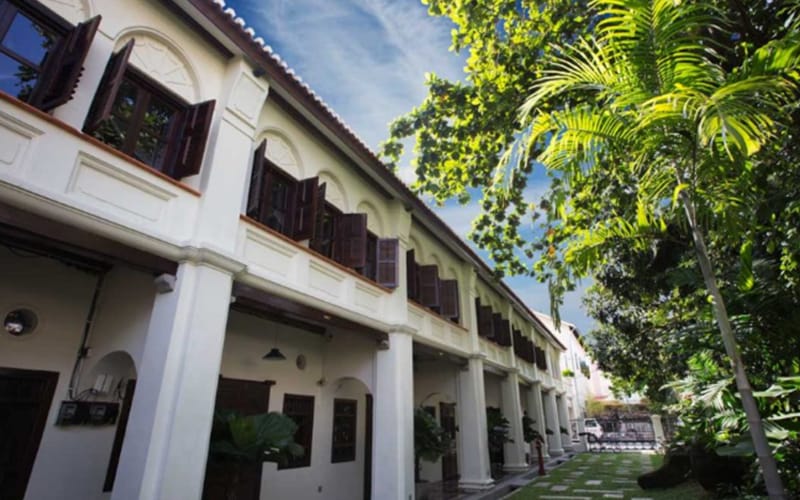
Muntri Grove
The 1880s workers' quarters of Muntri Street's Straits Chinese elite
Transparency
Why This Score
How each of the nine Heritage Hotel Index dimensions was evaluated.
Heritage & Authenticity
40% of HHIReview pending
Review pending
Review pending
Guest Experience
35% of HHIReview pending
Review pending
Review pending
Operational Excellence
25% of HHIReview pending
Review pending
Review pending
About the Property
Once the workers' quarters serving the prosperous Straits Chinese households of Muntri Street, Muntri Grove occupies a quiet cluster of 1880s shophouses set back from the main heritage corridor. The interiors balance period ceramic floor tiles and original timber ceiling beams against a spare contemporary aesthetic — a thoughtful restoration that honours the domestic vernacular of George Town's artisan class within the UNESCO heritage zone.
Original Purpose
Workers quarters for wealthy Muntri Street families
Highlights
History Timeline
Muntri Street develops as a prosperous residential address in George Town, home to wealthy Straits Chinese merchant families whose large townhouses require significant domestic staff and service quarters.
A row of modest workers quarters is constructed behind the Muntri Street mansions to house domestic servants, forming a self-contained alley community sheltered from the main street activity.
Japanese forces occupy George Town; the Muntri Street area, including its back-lane workers quarters, is subject to requisitions and population displacement during the wartime occupation.
Post-independence Penang sees the workers quarters converted to multi-family rental use as domestic service patterns change and former mansion owners subdivide their properties.
George Town UNESCO inscription raises heritage awareness; the hidden alley of mid-19th century shophouses behind Muntri Street is identified as a rare surviving example of domestic service architecture.
Muntri Grove opens as a boutique hotel, transforming the secret alley of workers quarters into a contemporary retreat while retaining the intimate scale and original building fabric.