Rachamankha Hotel
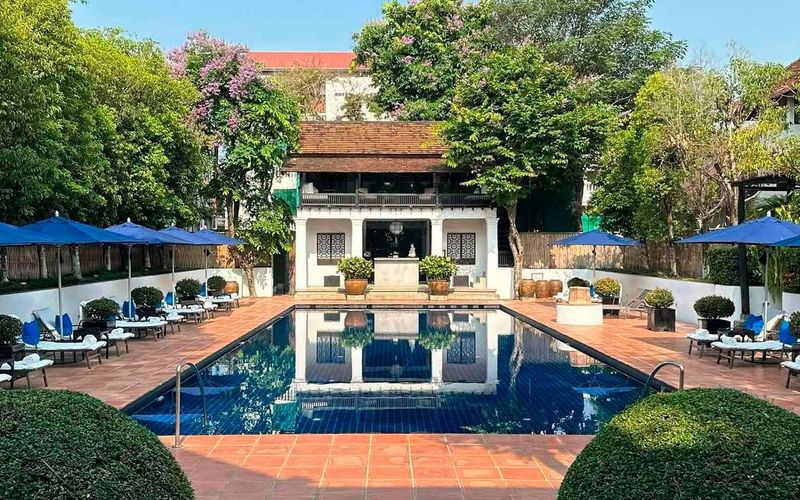
Lanna temple-compound geometry arranged around quiet courtyards and deliberate axes
Transparency
Why This Score
How each of the nine Heritage Hotel Index dimensions was evaluated.
Heritage & Authenticity
40% of HHIReview pending
Review pending
Review pending
Guest Experience
35% of HHIReview pending
Review pending
Review pending
Operational Excellence
25% of HHIReview pending
Review pending
Review pending
About the Property
Designed by architect Ong-ard Satrabhandhu to replicate the spatial grammar of a Lanna temple compound, Rachamankha arranges its guest pavilions, galleries and garden courts around axes of deliberate calm. Chinese courtyard influences layer over Lanna structural vocabulary — white-washed walls, dark timber columns, terracotta roof tiles — creating an environment of austere elegance on a quiet street inside Chiang Mai's ancient city walls.
Original Purpose
Boutique hotel
Highlights
History Timeline
King Mangrai establishes Chiang Mai; Buddhist temples including Wat Phra Singh are built within the moated square on the south-west quadrant of the old city.
Wat Phra Singh receives the Phra Singh Buddha image, brought from Chiang Rai, making the temple the spiritual centrepiece of Ratchamankha Road.
Chiang Mai's revival under Prince Kawila rebuilds the old-city temple precinct after decades of Burmese occupation and depopulation.
Thailand's Fine Arts Department classifies Wat Phra Singh as a national monument, prompting heritage zoning along the surrounding lanes.
Rachamankha Hotel opens, purpose-built to replicate a Lanna temple compound with Chinese courtyard influences, earning international design acclaim.
Rachamankha named one of the world's top small hotels by Condé Nast Traveller, praised for its scholarly approach to Lanna architectural heritage.